SPDM Tech

Capability · Model order reduction

From hours of FEM to milliseconds.

We condense a checked finite-element model into a compact one that gives the same answer for any load profile, in milliseconds. Fast enough for design studies, system simulation and the control unit itself.

Talk to us
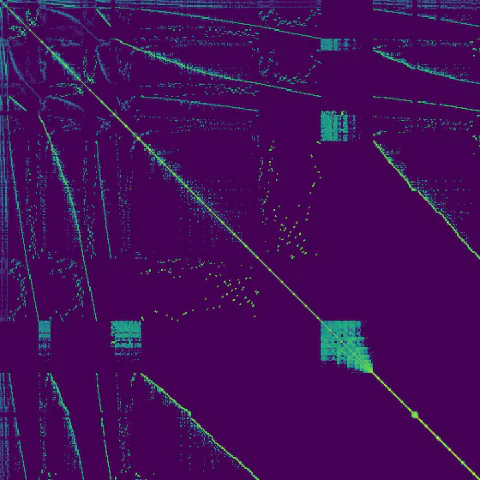
Sparsity pattern of the full conductivity matrix K K: 334 889 × 334 889
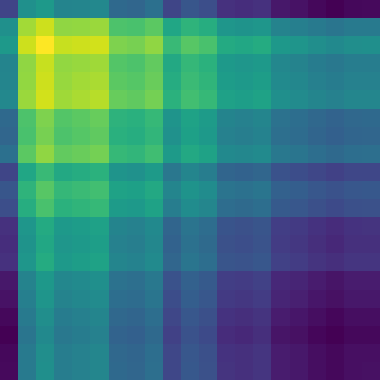
The reduced matrix, 21 by 21 Kr: 21 × 21
The same circuit board, before and after the reduction: 7.2 million nonzero entries become a 21 × 21 matrix.
  • 334 889 → 21Unknowns: the full thermal model of the board and its reduced model
  • 2 h 05 minCalculiX for one heat-up, 1 ms to 350 s. The reduced model: 1.3 ms
  • 0.003 KLargest difference to CalculiX, anywhere on the board, at any time
  • 0Training runs: the reduced model comes straight from the finite-element matrices

The result

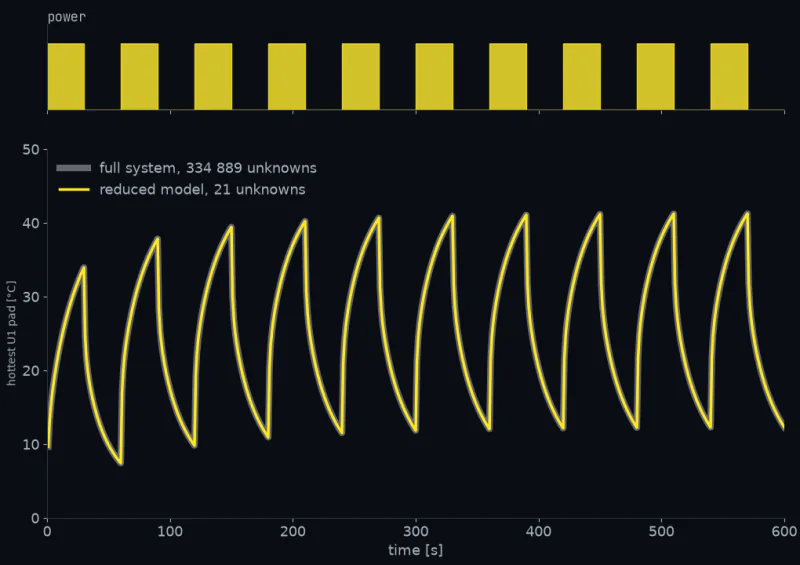
The reduced model on the CalculiX curve.

CalculiX, 334 889 unknowns Reduced model, 21 unknowns, computed in your browser

CalculiX
2 h 05 min
Reduced model
1.3 ms
Largest difference, anywhere on the board
0.003 K

Same 164 time steps, 1 ms to 350 s, all 334 889 nodes. The curve on the left is the hottest pad of the microcontroller, and your browser just computed it again: …

Try it

A new load, no new simulation.

Set your own power profile for the microcontroller. The reduced model of the board answers right here, in your browser.

Full system, 334 889 unknowns (41 s) Reduced model, 21 unknowns

Peak
At 600 s
Computed in

How it works

Four steps, each one a script you can rerun.

  1. 1 · Full model

    334 889 unknowns

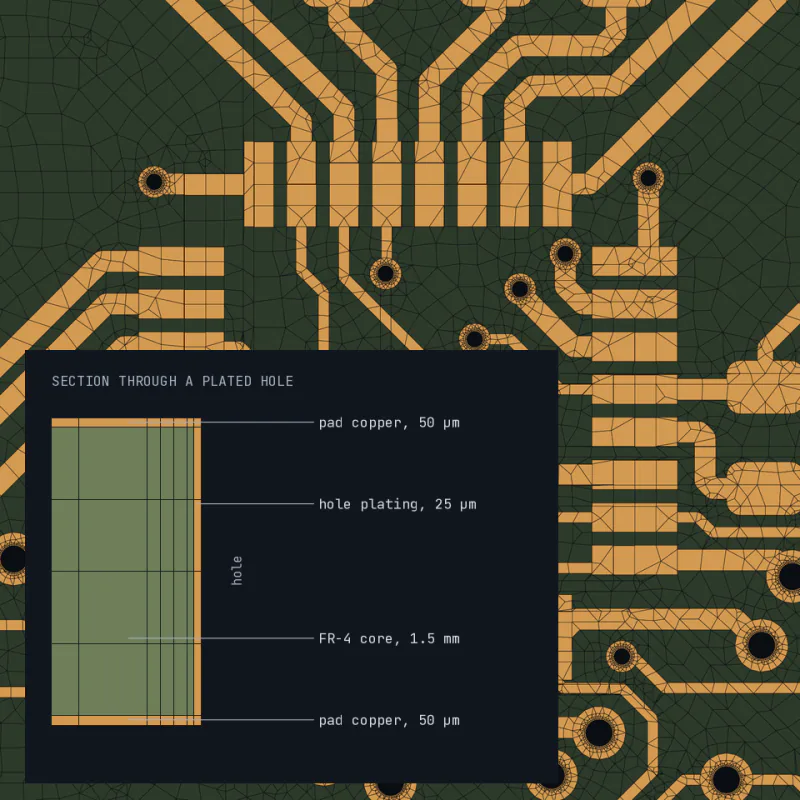
    The checked thermal model of the board, built from its Gerber files: layered elements, connected everywhere.

  2. 2 · Matrices

    K and C from CalculiX

    Conductivity, heat capacity and the load, exported by the solver. They reproduce its own result to 5·10⁻⁵ K.

  3. 3 · Reduction

    21 vectors, 7 time scales

    A Krylov projection captures the response from 1 ms to 1000 s. No fitting, no training data.

  4. 4 · Check

    Against the full system

    The heat-up and a new pulsed load, compared node by node with the full model.

The evidence

Every number comes with its check.

A reduced model is only useful if it is as trustworthy as the model it replaces. These checks are part of every reduction.

How many unknowns are enough? Largest difference, whole board
Reduced modelHeat-up30 s pulses
PRIMA, 10 unknowns1.77 K0.741 K
PRIMA, 20 unknowns0.942 K0.057 K
PRIMA, 40 unknowns0.56 K< 0.001 K
Rational Krylov, 14 unknowns0.041 K0.065 K
Rational Krylov, 21 unknowns0.003 K0.002 K
Rational Krylov, 33 unknowns< 0.001 K< 0.001 K
Decision dossierArduino Nano IO Shield
  • Matrices from CalculiXreproduce its field to 5·10⁻⁵ K
  • Size334 889 → 21 unknowns
  • Heat-up, 1 ms to 350 s0.003 K, whole board
  • New load: 30 s pulses0.002 K against the full system
  • Stable and passivesymmetric positive definite
  • Full system solved directly, 600 s of pulses41 s, the reduced model 4.5 ms

Beyond this board

Reduced where the physics allows, learned where it does not.

Model order reduction

Exact projection of the finite-element model.

For linear physics: heat transfer, structural dynamics, vibration. Stable by construction and checked against the full model.

  • Shown on this page: 334 889 → 21 unknowns
  • Any load over time, without a new simulation
  • Rebuilt in minutes when the design changes

Surrogate models

When the parameters change, or the solver is a black box.

A planned set of simulations, then a response surface, Kriging or neural network, each reported with its cross-validated prediction quality.

  • Geometry, material and cooling as parameters
  • Sensitivities: which inputs really matter
  • Built on years of work with optiSLang (optiSLang Award 2019)

Where they pay off

Wherever one answer is not enough.

Thousands of evaluations instead of one: in the design loop, the system model and the product itself.

  • Design studies, optimisation and robustness
  • System simulation and digital twins
  • Derating and monitoring in control units

Shown with results on this page: the model order reduction of the circuit board. Surrogate models for parameter studies are not shown here yet.

The whole story

From hours of FEM to milliseconds, in 71 seconds.

Assumptions: the thermal model of the PCB thermal page, linear (constant material values and convection), so the reduced model is valid for this layout, this cooling and these typical material values; change one and the reduction is rebuilt in minutes. Temperatures are rises above ambient air at the hottest of the 32 U1 pads. Times measured on the same machine: CalculiX on 8 cores for the log-spaced run with 164 time steps; the reduced model as the best of 20 runs; the full system with its matrices solved directly (one factorisation, 1 s steps). Against that direct solution the reduced model is still about 9000 times faster. Above 100 s the CalculiX curve is the run with 2.5 s time steps, and the reduced model in your browser uses the same steps.
Pilot partners wanted

Have a model that is too slow for the question? Let's reduce it.

SPDM Tech is in its build-up phase. As one of the first pilot partners, you bring one real question, from a circuit board, a drawing or a simulation process, and get a checked answer.

Become a pilot partner