Chapter 1
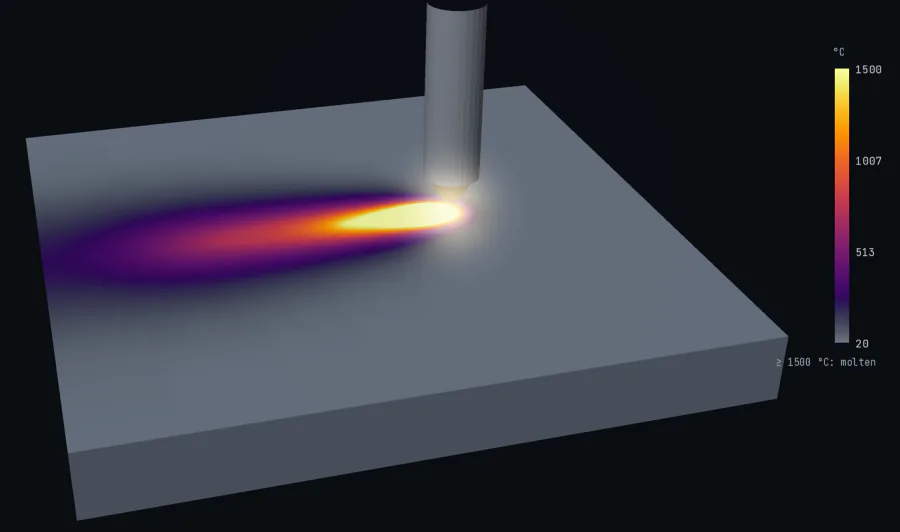
How big is the melt pool, and how fast does it cool?
Fusion zone, peak temperatures and the cooling time t8/5 for your heat input and plate thickness, without a trial weld.
See the weld thermalCapability · Process simulation
What a manufacturing process does to the material, before the first trial piece. Here a welding pass: from the heat source to the temperature in every point, then to the phases and the hardness it leaves behind, each step with its check.
Talk to us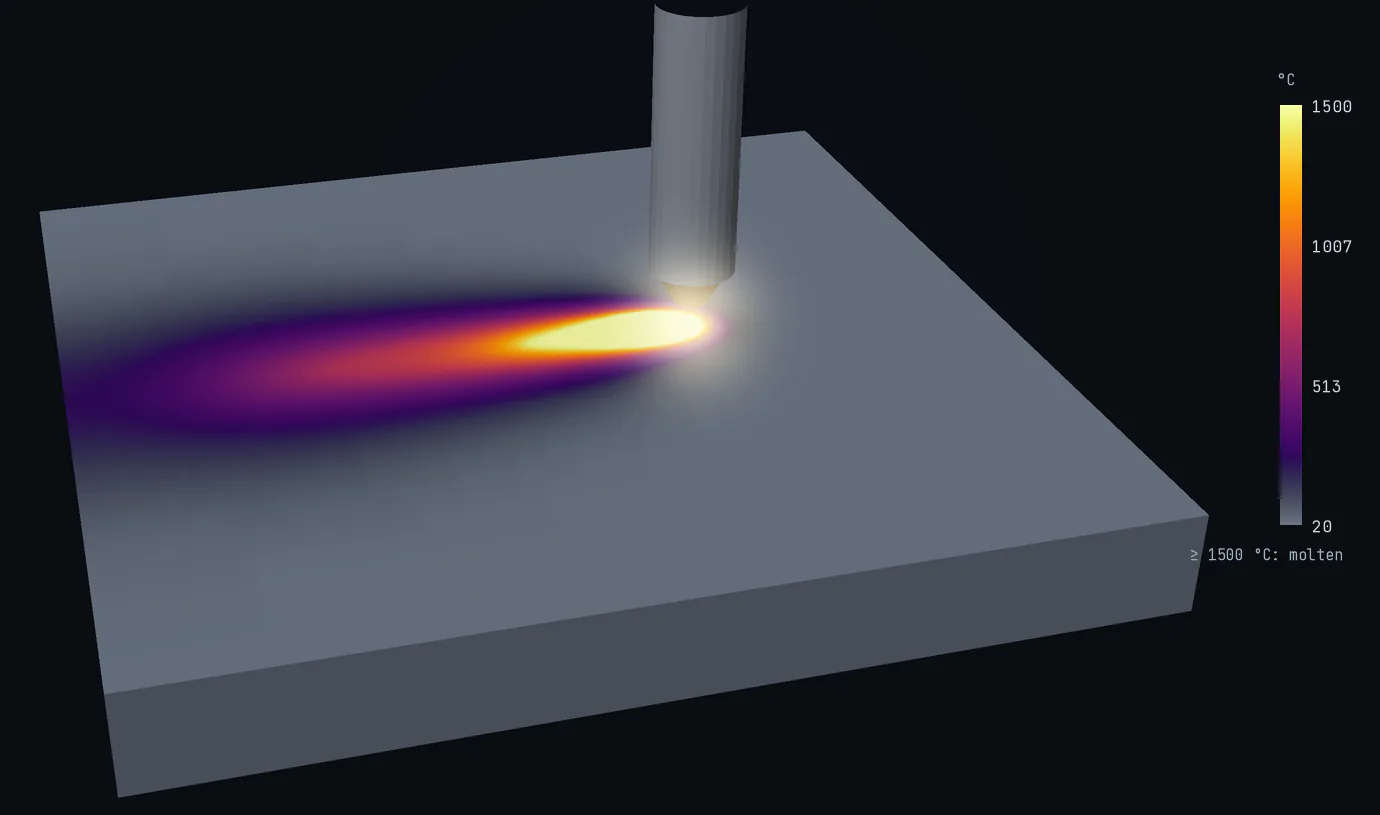
Two chapters
Chapter 1 · Weld thermal
A moving heat source welds two 16 mm plates. Melt pool, peak temperatures and the cooling time from 800 to 500 °C, checked against the standard.
8.65 s vs 9.2 st8/5 against EN 1011-2
Chapter 2 · Microstructure and hardness
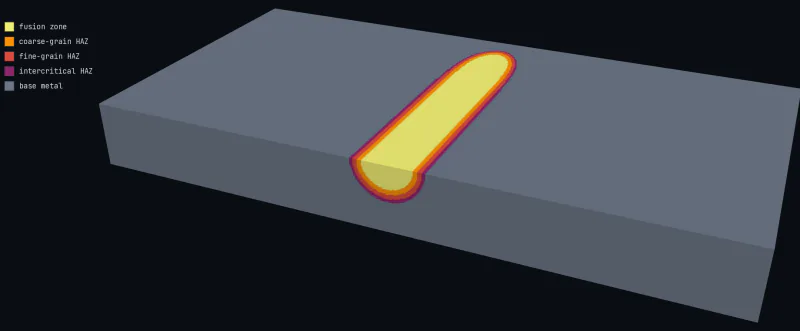
From every point's thermal cycle to its phases and hardness. Fusion zone, three heat-affected zones and the unchanged plate.
160 → 285 HVPlate to the hardest point of the heat-affected zone
Next · not shown yet
The same thermal cycles in a structural model: how far the plates pull and what stress stays in them. Then several passes, and other processes such as heat treatment.
Questions it answers
Chapter 1
Fusion zone, peak temperatures and the cooling time t8/5 for your heat input and plate thickness, without a trial weld.
See the weld thermalChapter 2
Phases and hardness in every zone, from the thermal cycle of each point. Follow five points through the pass on the page.
Follow the thermal cyclesChapter 2
The cooling time decides between martensite and ferrite. See how the hardness of the coarse-grain zone follows it.
Change the cooling timeThe whole story
The evidence
The thermal model is checked before the microstructure builds on it. The details are in each chapter.
Assumptions: the process values (30 V, 300 A, 300 mm/min), the shape of the heat source and the chemical composition are typical values, not measured; the heat source is not yet calibrated against a macro section of a real weld. Thermal properties of the steel and the arc efficiency are standard values. The transformation kinetics is a published model from the composition. Distortion and residual stress are not part of this simulation.
Pilot partners wanted
SPDM Tech is in its build-up phase. As one of the first pilot partners, you bring one real question, from a circuit board, a drawing or a simulation process, and get a checked answer.