SPDM Tech

Chapter 2 · Microstructure and hardness

One pass, five different steels.

Every point of the plate has its own thermal cycle from chapter 1: how hot it got and how fast it cooled. From that cycle and the composition of the steel follow the phases that form, and from the phases the hardness.

Talk to us
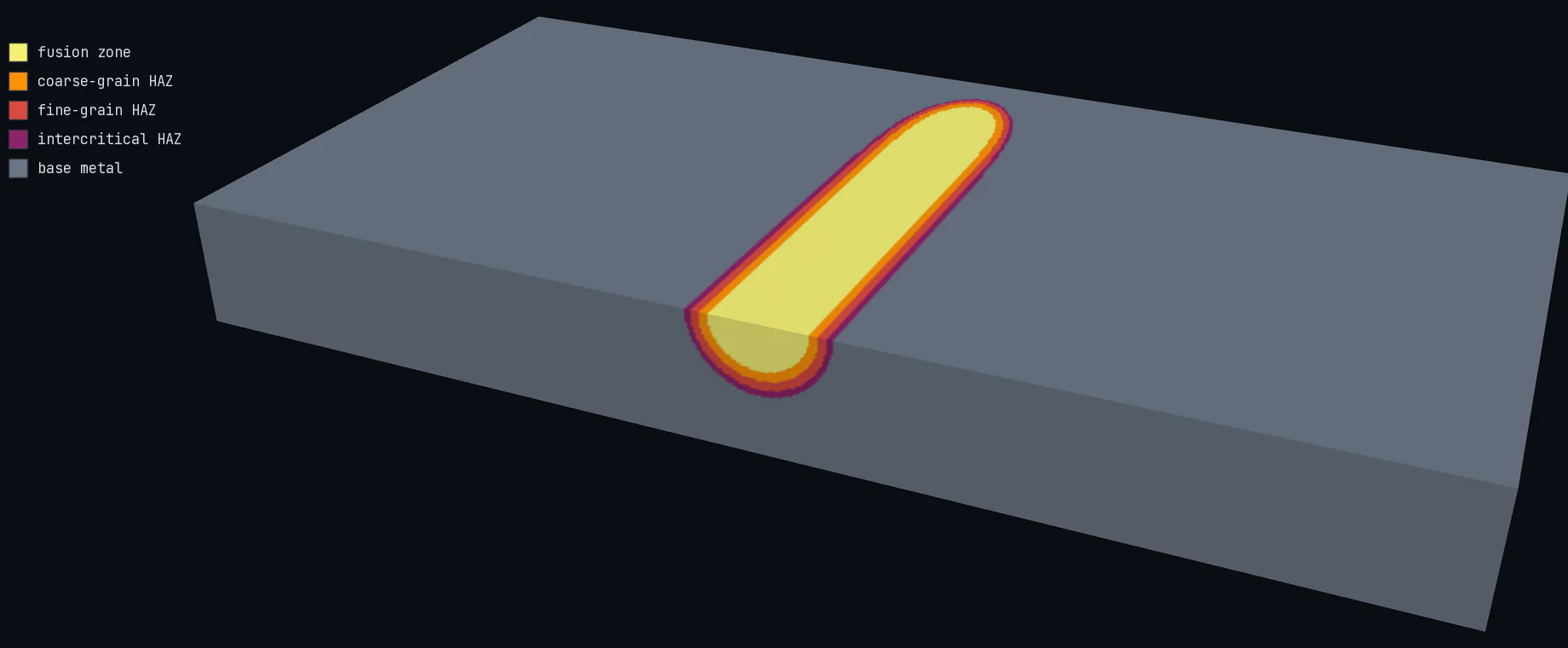
The welded plate cut open at the arc start: fusion zone, three heat-affected zones and the base metal, coloured by the highest temperature reached
The zones along the whole weld, coloured by the highest temperature each point reached
  • 285 HVHardest point of the heat-affected zone, in its coarse-grain part
  • 300 HVMean hardness of the fusion zone, 86 % bainite
  • 160 HVThe plate itself, beyond 8 mm from the joint line
  • -14 %Against a published hardness formula (332 HV), without any tuning

The result · follow five points

Five thermocouples, one pass.

Five virtual thermocouples on the top face, halfway along the weld, one in each zone. Move through the 272 computed time steps: the arc passes, each point heats up and cools down, and its phases form on the way.

Time since the arc started, logarithmic · shaded: 800 → 500 °C · dashed: transformation temperatures

#From jointZoneNowPeakt8/5Phases nowFinal
1 0 mm fusion zone 308 HV
2 6 mm coarse-grain HAZ 285 HV
3 7 mm fine-grain HAZ 230 HV
4 8 mm intercritical HAZ 196 HV
5 10 mm base metal 160 HV
  • austenite
  • ferrite
  • pearlite
  • bainite
  • martensite
  • base metal, unchanged

The section · x = 76 mm

Four zones, four different structures.

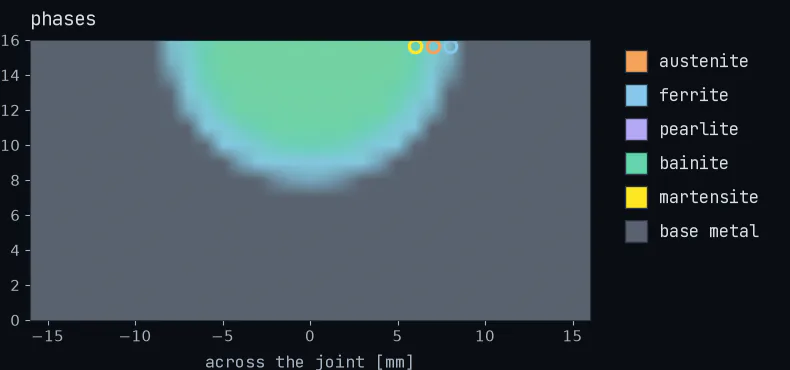
Cross-section of the weld coloured by phase: bainite in the fusion zone, ferrite at its edge, base metal outside
Phases in the section after cooling, half of it mirrored. The three rings mark points 2–4.
  • Fusion zone300 HV · max 308
    bainite 86 % · martensite 8 %
  • Coarse-grain HAZ264 HV · max 285
    ferrite 19 % · pearlite 5 % · bainite 75 %
  • Fine-grain HAZ200 HV · max 230
    ferrite 65 % · pearlite 9 % · bainite 26 %
  • Intercritical HAZ175 HV · max 196
    ferrite 35 % · bainite 10 % · unchanged 51 %

Means over the section's grid points in each zone. In the intercritical zone only part of the steel turned into austenite, so half of it stays as it was.

What if · faster or slower

The cooling time decides the hardness.

The coarse-grain zone next to the fusion line, cooled at other rates. A shorter t8/5 (less heat input, a thicker or colder plate) gives martensite and a hard zone; a longer one gives ferrite and pearlite.

Hardness of the coarse-grain zone · ring: this weld

Hardness

Along the weld

Hardness from the computed phases.

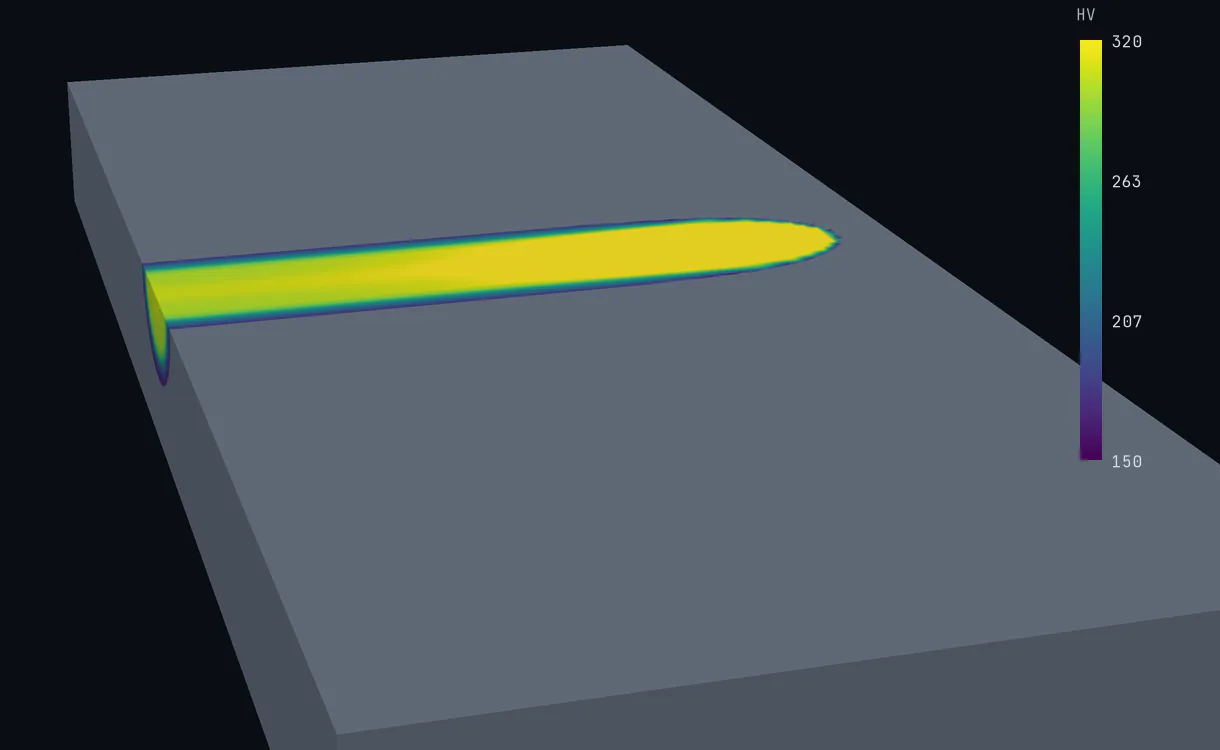
Hardness on the top face and the end face of the welded plate
Hardness on the top face and the end face; the plate in grey at 160 HV. Near the start and the end of the weld it cools faster and gets harder.

Inputs · every value has an origin

The composition decides as much as the cycle.

Without a mill certificate, the composition is a typical one for S355J2. With the certificate of your plates, the same model runs on their real chemistry.

  1. assumedChemical composition
    • C 0.17 · Si 0.25 · Mn 1.4 · Ni 0.05 · Cr 0.05 · Mo 0.02 · Cu 0.05
    Typical S355J2 values, no mill certificate yet
  2. sourceTransformation kinetics
    • published model from the composition
    Ferrite, pearlite and bainite with additivity, martensite below Ms
  3. assumedGrain size and base metal
    • ASTM 9 → 3 with the peak · 160 HV
    Coarser grain near the fusion line; the unaffected plate

The evidence

Checked against a formula it was not fitted to.

Welding engineers estimate the maximum hardness from the composition and t8/5. The model stays 8–15 % below that formula over the whole range of cooling times, without any tuning.

Decision dossierMicrostructure
  • Maximum HAZ hardness against the Düren formula285 vs 332 HV (-14 %)
  • Coarse-grain HAZ at t8/5 3 s and 26 s, against Düren399 vs 434 · 197 vs 224 HV
  • Phase fractionsadd up to 1, no austenite left
  • Transformation sub-step 2 → 1 K≤ 0.7 HV
  • Coarse against fine gridhardness within 4.7 %

Assumptions: typical S355J2 composition (C 0.17, Si 0.25, Mn 1.4, Ni 0.05, Cr 0.05, Mo 0.02, Cu 0.05 %), not from a mill certificate. Austenite grain size from the peak temperature (assumed), base metal 160 HV (typical). Transformation temperatures Ae1 715, Ae3 837, Bs 575 and Ms 423 °C from the composition, at equilibrium: fast heating shifts Ae1 and Ae3 up in reality. Kinetics and hardness per phase from published models. One pass, no tempering by later passes. The thermal cycles are those of chapter 1, with its assumed heat source.

Pilot partners wanted

Have a hardness limit for your welds? Let's check it before the procedure test.

SPDM Tech is in its build-up phase. As one of the first pilot partners, you bring one real question, from a circuit board, a drawing or a simulation process, and get a checked answer.

Become a pilot partner